Listed Buildings & Conservation Areas
What’s the difference – and what does it really mean for maintenance?

Hello and Welcome
My first post here builds on my most popular Blogspot article and returns to a couple of questions I am still asked regularly, particularly by owners of older and historic buildings:
As the owner of a Listed Building, what restrictions are there? Can’t I just carry on with maintenance?
What does it actually mean to live in a Conservation Area – and is it the same as owning a Listed Building?
These questions usually come up early in conversations, especially in Llandeilo, often when something has already started to fail – a roof, windows, a wall – and it is completely understandable that the terminology and process can feel confusing. You are definitely not alone in thinking that.
The short answer to both questions is “no” – they are not the same – but understanding the difference early can make projects clearer, calmer and far more manageable. Knowing the difference may also inform you if you are considering a property purchase, understanding that there are responsibilities as custodians of properties but also seeing that this does not limit you to being unable to do anything. Let’s break it down.
A quick note on what I plan to write about here
This Substack is a new space where I will be sharing thoughts, practices and processes drawn from my work with listed buildings, conservation areas and sensitive sites. That includes reflections on real projects, common pitfalls, how decisions are made, the extensive list of consultants needed to gain planning and why certain permissions are needed.
If you would like to see examples of completed or ongoing projects, those are best viewed over on Instagram, Facebook, or my Blogspot, where I have shared drawings, photos, briefs and updates. Here, I am more interested in explaining the why behind the work.
Listed Buildings – what that actually means
Let’s start at the beginning; Listed Buildings are designated because of their special architectural or historic interest and they fall into three grades:
Grade I (highest) – buildings of exceptional interest
Grade II* – particularly important buildings of more than special interest
Grade II – buildings of special interest
The purpose of Listed Building Consent is not to prevent change, but to manage it carefully, so that what makes a building, landscape or collective special is not lost over time.
One of the most important things to understand (and the one thing that is most often incorrectly quoted) is that a listing applies to the entire building – inside and out. It is not just about front elevations, windows, fireplaces, staircases or decorative plasterwork.
Significance often lies in:
The overall form and layout
How the building has evolved
Traditional construction methods and materials
Even spaces that feel quite plain or utilitarian
Very often, it is the whole rather than the individual parts that matters most.
“It is just maintenance” – is consent really needed?
This is probably the most common misconception and question asked.
For listed buildings, maintenance can still require consent, particularly where it goes beyond like-for-like repair or affects historic fabric. That can include:
Replacing windows or doors
Roof works that alter materials or details
Internal alterations
Removing or changing historic elements
In other words, if the work affects the character of the building, it is likely to need Listed Building Consent – whether or not planning permission is required as well (that is another consideration).
That said, gaining consent is often far less daunting than it sounds - and do not worry if you have already started before realising that your work requires permission, using a retrospective application we can get your work reviewed, the correct permissions in place and work back on track.
Heritage Statements – why they matter
A well-prepared Heritage Statement sits at the heart of most successful Listed Building applications.
This is not about creating barriers. It is about:
Understanding the building’s history
Identifying what contributes to its significance
Acknowledging previous changes (good and bad)
Using that information to justify sensible, proportionate design decisions
Done properly, this research does not just support the application – it actively informs better design, gives the project direction and gives clarity and confidence to everyone involved.
A real example – Llandeilo
One recent project in Llandeilo is a good illustration of how this works in practice.
Listed Building Consent was secured for repairs to a historic shopfront, with options for both:
A temporary repair, to halt deterioration
A long-term solution, involving upgraded materials
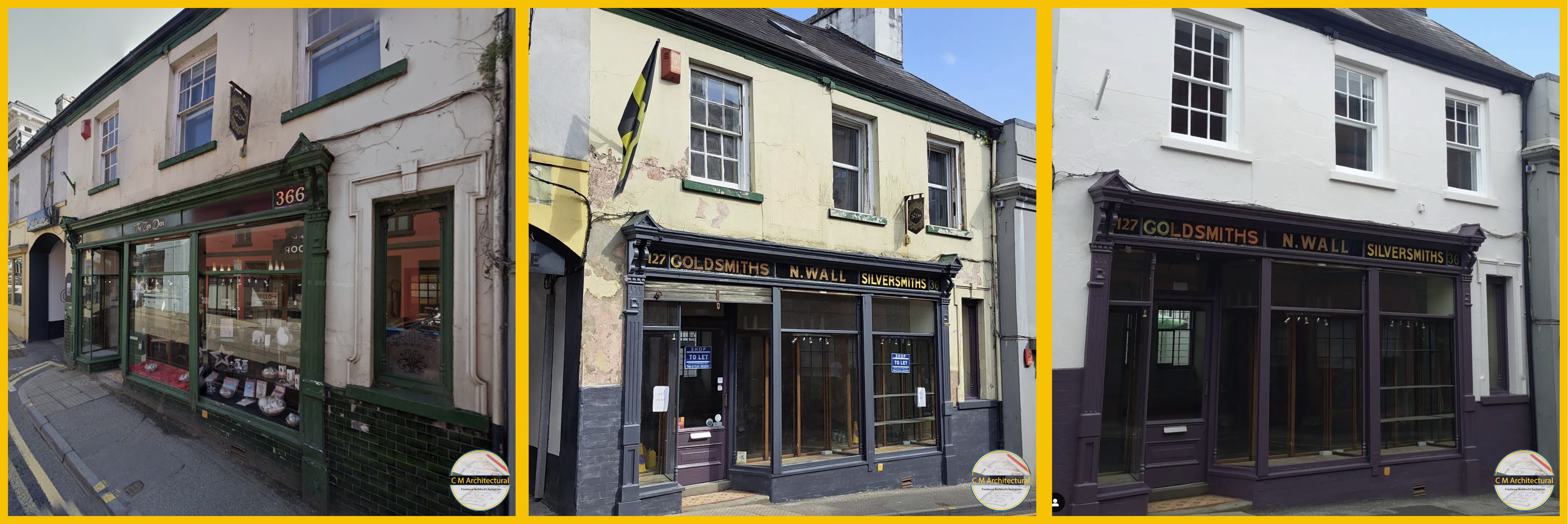
Interestingly, the building was sold during the process and the permission transferred to the new owner – something that can feel alarming but is actually quite straightforward when handled correctly.
Research for the Heritage Statement showed that the tiles to the lower front elevation did not have the age first thought and they had been painted historically. That precedent allowed consent to be granted for repainting now, with full replacement approved as a future phase due to their poor condition.
The first stage of works has since been completed and the response from the local community was genuinely encouraging. It is always reassuring to see how much people care about the character of their town.
Conservation Areas – similar, but not the same
Conservation Areas focus on the wider setting, rather than individual buildings. They are designated because the area as a whole has special architectural or historic interest.
This includes things like:
Groups of buildings
Street patterns
Materials and detailing
Trees and open spaces
Being in a Conservation Area does not mean development can not happen. It does mean that proposals are assessed with an extra layer of consideration: how will this affect the character of the area?
What typically needs consent in a Conservation Area?
Certain works are more tightly controlled, including:
Demolition of buildings (over a certain size)
Demolition of walls, gates, fences or railings
Works to trees
Some advertisements and external alterations
The guiding principle here is significance – a concept that runs throughout Planning Policy Wales. Decisions are about whether proposals preserve or enhance what makes the area special, not about stopping change altogether.
Focus – Llandeilo Conservation Area
Carmarthenshire County Council have previously commissioned Donald Insall Associates to carry out studies of conservation areas across the county.
For now, the Conservation Area Character Appraisal and Management Plan - Llandeilo Conservation Area can be found here: Llandeilo CA Appraisal. It is quite a long read but has some very interesting points.
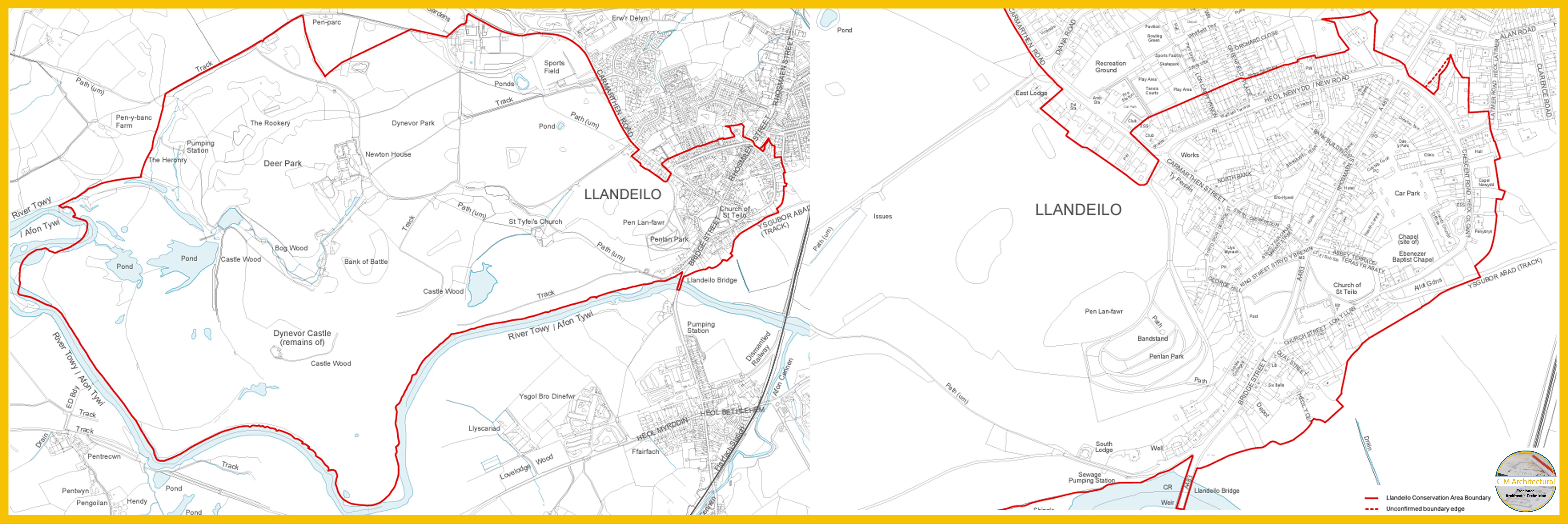
This map, which forms part of the report, indicates the limit of the conservation area in Llandeilo, with a small area off Crescent Road suggested for addition in to it:
In addition to the conservation area reports Donald Insall Associates have produced a Carmarthenshire Shopfront Design Guide 2022. The aim of this is “to help celebrate the character of historic shopfront design within the county and support the regeneration of towns to ensure their continued commercial success”. Again, it is quite a long read but has some interesting points.
Hopefully there will be some residential design guidance that comes from CCC following these reviews as currently the approach in Llandeilo is not that clear to those living in the Conservation Area.
Demonstrating this, Nathan Goss was welcomed by the Llandeilo and District Civic Society to present a fascinating talk recently on the architectural character of Llandeilo. It led me to review part of this; Are We at Risk of Losing the Charming Character of Llandeilo? - Seeing Llandeilo with Fresh Eyes.
As soon as something more is published I shall post a further review.
A final thought
What I see time and again is that owners are often surprised by how many permissions and consultants may be needed for what feels like necessary or straightforward maintenance.
It can feel daunting at first – particularly when ecology, heritage, planning and building regulations overlap – but with the right approach, these processes are entirely achievable without duplicating work. More than that, they often lead to better, longer-lasting outcomes for the building.
If you are dealing with a listed building or a property in a Conservation Area and feeling unsure where to start, you are not alone – that is where I come in! Asking early usually makes all the difference, so please get in touch.
If this is the sort of content you find useful, I am planning to publish roughly once a month, sharing practical insight from live projects and real situations.
Feel free to subscribe, reply with questions, or suggest topics you would like me to cover in future posts.
Thanks, Charlotte